


McGlothlin-Street Hall
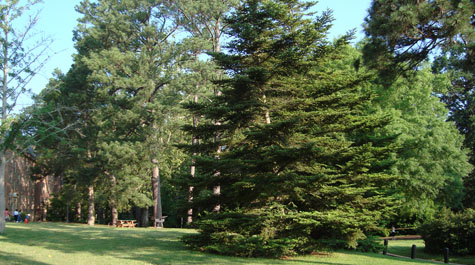 Abies firma A pair of momi firs.
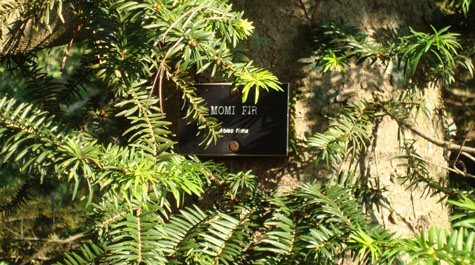 Nameplates Many trees in the collection have identifying tags. These consist of a plastic nameplate adhered to a piece of treated wood, nailed directly into the tree. This technique allows the tags to "grow" with the tree rather than becoming covered with bark.
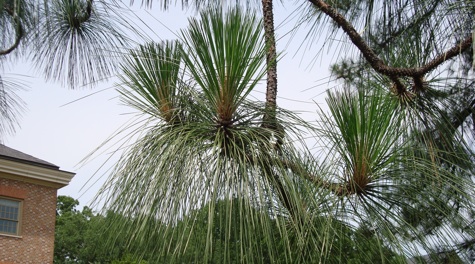 Pinus palustris longleaf pine
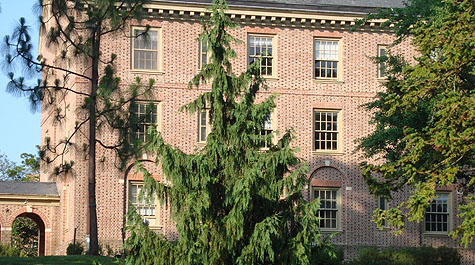 Chamaecyparis nootkatensis Alaska cedar
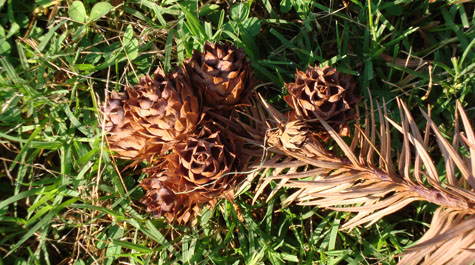 Cunninghamia lanceolata Close-up showing cones of the China fir.
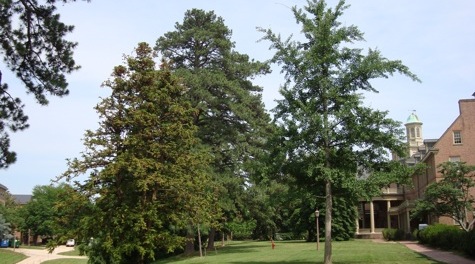 Ginkgo biloba The Ginkgo (at right) is the only tree species with a fan-shaped leaf.
The sloping area between McGlothlin-Street Hall and the residence halls to the south contains a number of interesting specimens. On the west end as you enter this area, note the pair of momi firs (Abies firma), a species native to central and southern Japan. Its scientific name is very descriptive of the very firm, plastic-feeling leaves. Other notable species in this area are Alaska cedar (Chamaecyparis nootkatensis), a China fir (Cunninghamia lanceolata), and a longleaf pine (Pinus palustris).
Mature specimens of longleaf pine can reach more than 100 feet in 150 years and can survive for 500 years. Before heavy logging in the eighteenth and nineteenth centuries the longleaf pine comprised a dense forest of an estimated 90 million acres, stretching from Virginia south to Florida and then west to Texas. Only three percent of that stand survives today. Soft and easily worked when fresh-cut, the longleaf pine has a very high concentration of resin that hardens over time. It was the timber of choice for building ships (also supplying resin and turpentine), warehouses, and many antebellum houses. The wide plank flooring often referred to as "heart pine" in our region is usually made of longleaf pine. If you have any doubt why it is named long-leaf, compare the needles (leaves) to our most common pine, the loblolly (Pinus taeda), growing right beside it to the east.