 Skip to main content

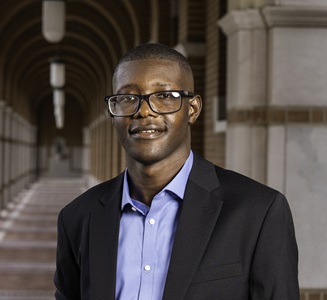
Abdoulie Jabang
Office:
Blair 313
Email:
[[ajabang]]
Regional Areas of Research:
Modern Africa, Senegambia and The Gambia
Thematic Areas of Research:
Environmental History; Histories of Development, Technology, Energy, Imperialism, Citizenship; Regimes of Power: Class, Gender, Class, Masculinity, Generational and Religious Difference, and Inequality
Bio
Dr. Abdoulie Jabang is a historian of modern Africa with a focus on environment, technology, development, and inequality. Dr. Jabang received his PhD in African History from Michigan State University. Prior to joining William & Mary, he served as a Postdoctoral Fellow at Rice University and was recently an Assistant Professor in the Department of History at Texas Christian University. His research explores new insights into the workings of power and inequality, grounded in multilayered human interactions with the non-human world and technological development schemes in the Gambia, from the 18th century to the present.
Dr. Jabang’s current book project, Reproducing Inequalities: The Environmental Origins of Power and Injustice in the Gambia River Region, 1700-1990 examines how statecraft and regimes of power rooted in class, religion, and gender, have individually and collectively, shaped and reshaped access to productive environmental resources (i.e. land and river) along the Gambia River before and after colonial rule. It further explores how colonial policies interacted with these regimes of power, turbocharging environmental inequalities into the postcolonial period. Drawing on a wide range of underutilized oral and textual records, cartographic and built forms, this study contends that successive environmental control and management schemes of both precolonial and colonial state produced and reproduced states for the dominant ruling class, while subjecting lower classes, marginalized non-Muslims, and women to environmental dispossession and injustice. Through a variety of strategies such as flight, relocating communities in hard-to-reach ecologies, cultivating patronage relationships with ruling elites, and contesting elites’ confiscation of their resources, the disinherited communities demonstrated environmental resilience and autonomy, revealing the incomplete nature of state power.
By analyzing how marginalized classes and genders subverted elites’ control over their environments, this manuscript reveals historical continuities and changes in how human interactions with the environment were informed by colonially induced inequalities and those that predated colonial rule. This project suggests that understanding the roots of global contemporary environmental injustice requires careful attention to systems of inequalities that were reinforced by colonialism but predated and outlived colonial rule. Dr. Jabang’s research has been funded by various institutions, including the Social Science Research Council, Michigan State University’s Center for Gender in Global Context, Texas Christian University, and Rice University.