


VIMS assists in oil-spill drill
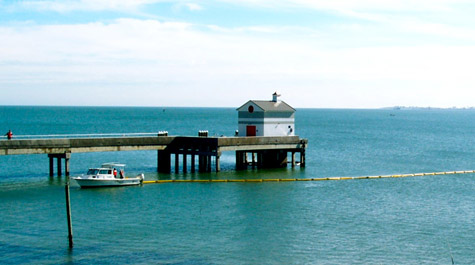 Oil spill drill Captain Voight Hogge of the Chesapeake Bay National Estuarine Research Reserve program at VIMS pilots the RV Moray during the oil-spill drill on October 28th. Onboard were members of the Newport News Fire Department, who deployed a containment boom near VIMS' new concrete pier. The pier holds the intake lines for the Institute's Seawater Research Laboratory. Photo courtesy of VIMS
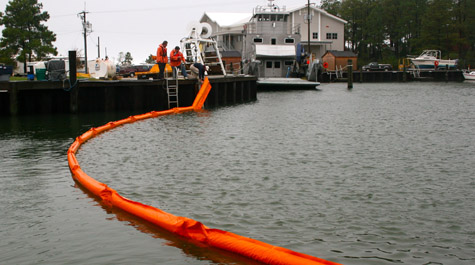 Oil spill drill VIMS vessel crew Mark Preisser, Ray Forrest, and Jim Barger secure one end of the oil-containment boom to the bulkhead in the VIMS Boat Basin. Photo courtesy of VIMS
Faculty and staff of the Virginia Institute of Marine Science, College of William and Mary, participated in yesterday's oil-spill exercise on the York River, which was designed to help federal, state, and local emergency-management teams better coordinate their individual and collaborative responses to such an event.
Numerous parties were involved in the drill, including the U.S. Coast Guard, Western Refining-Yorktown, the National Oceanic and Atmospheric Administration, the Virginia Department of Environmental Quality, the Virginia Marine Resources Commission, and several county emergency-response units.
Dr. William Reay, Director of the Chesapeake Bay National Estuarine Research Reserve at VIMS, led the Institute's participation in the exercise from the drill command center at the Western Refinery in Yorktown. Part of NOAA's national research reserve program, CBNERR owns and manages four pristine wetland sites along the York River estuary, including the Goodwin and Catlett islands.
"Care and good planning by maritime interests on the York River have thankfully prevented us from having to deal with any major oil spills," says Reay. "But, given the amount and nature of maritime traffic on our river, the possibility of a spill always exists, and we all take our responsibility to respond quickly and effectively very seriously."
In addition to Western Refining's Yorktown refinery, the York River is home to the Naval Weapons Station Yorktown, the U.S. Coast Guard Yorktown Training Center, and VIMS. It also serves numerous commercial and recreational fishing interests, recreational boaters, and beach-goers.
During the all-day drill, responders tested communication channels, checked emergency-response vessels and equipment, and conducted assessment over-flights. Information gained during the exercise will be used to refine and improve emergency-response plans.
At Gloucester Point, VIMS Vessels Operations staff used the occasion to practice deploying their oil-spill containment booms. The booms are designed to protect the VIMS Boat Basin and its vessels from any oil spill on the river, and also to protect the river from an oil spill in the Boat Basin.
Vessels Operation director George Pongonis says the boom system at VIMS is unusual in that its two separate components operate like a lock, allowing vessels to enter or exit while at the same time keeping oil in or out. The design is important, he says, "because it would allow us to deploy vessels to help manage a spill on the river, while preventing any of the spilled oil from entering and contaminating our own harbor."
VIMS vessels, captained by Jim Goins and Voight Hogge, supported additional exercise efforts at Gloucester Point. Crewmembers, including a HAZMAT team from the Newport News Fire Department, deployed a containment boom near VIMS' new concrete pier, which holds the intake lines for the Institute's Seawater Research Laboratory. The crew also deployed a boom near the pumps that supply water to the Institute's Oyster Hatchery.