 Skip to main content


Equipment, Viruses, and Monsters in the Lab
We don't have a full list of all the new equipment and happenings that occurred in 2009, but here's a sampling from the Williamson lab
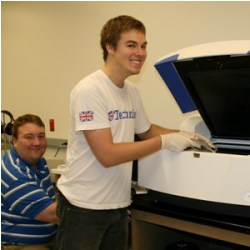 Kurt Williamson was hired for our Virology position in the
2008-2009 academic year. Viruses are small - about 100 times smaller than
bacteria. So for Williamson's research, a Transmission Electron
Microscope (TEM) is typically used to look at viruses. Unfortunately,
the Biology Department's TEM, which is over 30 years old, broke down
this past summer. Dr. Williamson has submitted an equipment grant
to purchase a new, state-of-the -art TEM for the College.
Kurt Williamson was hired for our Virology position in the
2008-2009 academic year. Viruses are small - about 100 times smaller than
bacteria. So for Williamson's research, a Transmission Electron
Microscope (TEM) is typically used to look at viruses. Unfortunately,
the Biology Department's TEM, which is over 30 years old, broke down
this past summer. Dr. Williamson has submitted an equipment grant
to purchase a new, state-of-the -art TEM for the College.  In the
meantime, Williamson found a used TEM on eBay, of the same vintage as
the old scope that recently failed - and he won the bid for $1,000!
With help from many of the faculty and staff in the Biology
department, including Eric Bradley, Tom Meier, John Griffin, Evguenia
Orlova, Joe Scott, and Brandt Robertson (Applied Research Lab), and
departmental financial support from our Chair, Liz Allison, Williamson
was able to install the used TEM, hire external technical support, and
get all systems up and runnning. He has recently produced images of a
virus. We still need a modern, up-to-date TEM, but the editors of The
Niche tip our hats to Williamson's persistence, especially since
the study of viruses is of such interest in the field of biology.
In the
meantime, Williamson found a used TEM on eBay, of the same vintage as
the old scope that recently failed - and he won the bid for $1,000!
With help from many of the faculty and staff in the Biology
department, including Eric Bradley, Tom Meier, John Griffin, Evguenia
Orlova, Joe Scott, and Brandt Robertson (Applied Research Lab), and
departmental financial support from our Chair, Liz Allison, Williamson
was able to install the used TEM, hire external technical support, and
get all systems up and runnning. He has recently produced images of a
virus. We still need a modern, up-to-date TEM, but the editors of The
Niche tip our hats to Williamson's persistence, especially since
the study of viruses is of such interest in the field of biology.
Kurt Williamson's work with environmental viruses has already fit in well in the department, recently collaborating with Mark Forsyth and Margaret Saha looking at viruses that attack bacteria. Read more in the Ideation Magazine's story of the discovery of a bacteriophage found right on campus, Freshman discoveries: It came. Out of the muck of Crim Dell....
 Last spring, Williamson also oversaw purchase of a new phosphoimager
and gel scanner: the "Storm 485". The multi-functional instrument
will be of use to a variety of lab groups using gel electrophoresis to
separate proteins or DNA fragments, or groups using autoradiography.
The Storm can capture digital images of gel separations that use blue
fluorescence to detect samples - DNA or proteins. The phosphorimager
capablities enable the detection of radioactively labeled samples,
with higher sensitivity than conventional autoradiogrphy with X-ray
film.
Last spring, Williamson also oversaw purchase of a new phosphoimager
and gel scanner: the "Storm 485". The multi-functional instrument
will be of use to a variety of lab groups using gel electrophoresis to
separate proteins or DNA fragments, or groups using autoradiography.
The Storm can capture digital images of gel separations that use blue
fluorescence to detect samples - DNA or proteins. The phosphorimager
capablities enable the detection of radioactively labeled samples,
with higher sensitivity than conventional autoradiogrphy with X-ray
film. 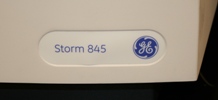 The Storm is currently housed in the newest common lab room set
up on the second floor of the ISC (formerly Rogers Hall) and is
available to all faculty and student researchers in the department.
The Storm is currently housed in the newest common lab room set
up on the second floor of the ISC (formerly Rogers Hall) and is
available to all faculty and student researchers in the department.
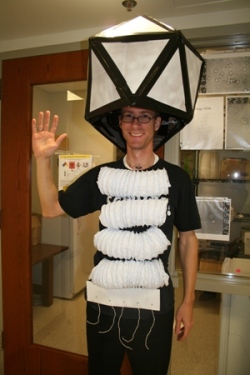
In unrelated news: a friendly, but ginormous virus was spotted in the halls outside the Williamson phage lab Friday, October 30, coincidentally the day before Halloween. Department Chair Liz Allison quickly adjusted to the new order, stating "I for one am happy to welcome our new viral overlords" .